For social agencies · taking the first cohort
Your production team,
minus the production.
One brief per client per month becomes a full calendar of finished posts — planned, art-directed, rendered, and approved by your client through a single link that carries your logo and never ours.
~3 days
A client's month, briefed to approved
~1.5 hours
Of your team's time in that month
2–4 weeks
What the same month costs today
Those first two are our own end-to-end walk-through of one client month, not an industry survey. The third is the 2–4 weeks and 15–25 hours the same month takes on a stitched stack — measured the only honest way we can: against how we used to do it.
The loop, shown
Five screens. That’s the entire product.
Every image below is the working product on live client data, captured this week. Nothing here is a mockup, and nothing here is coming soon.
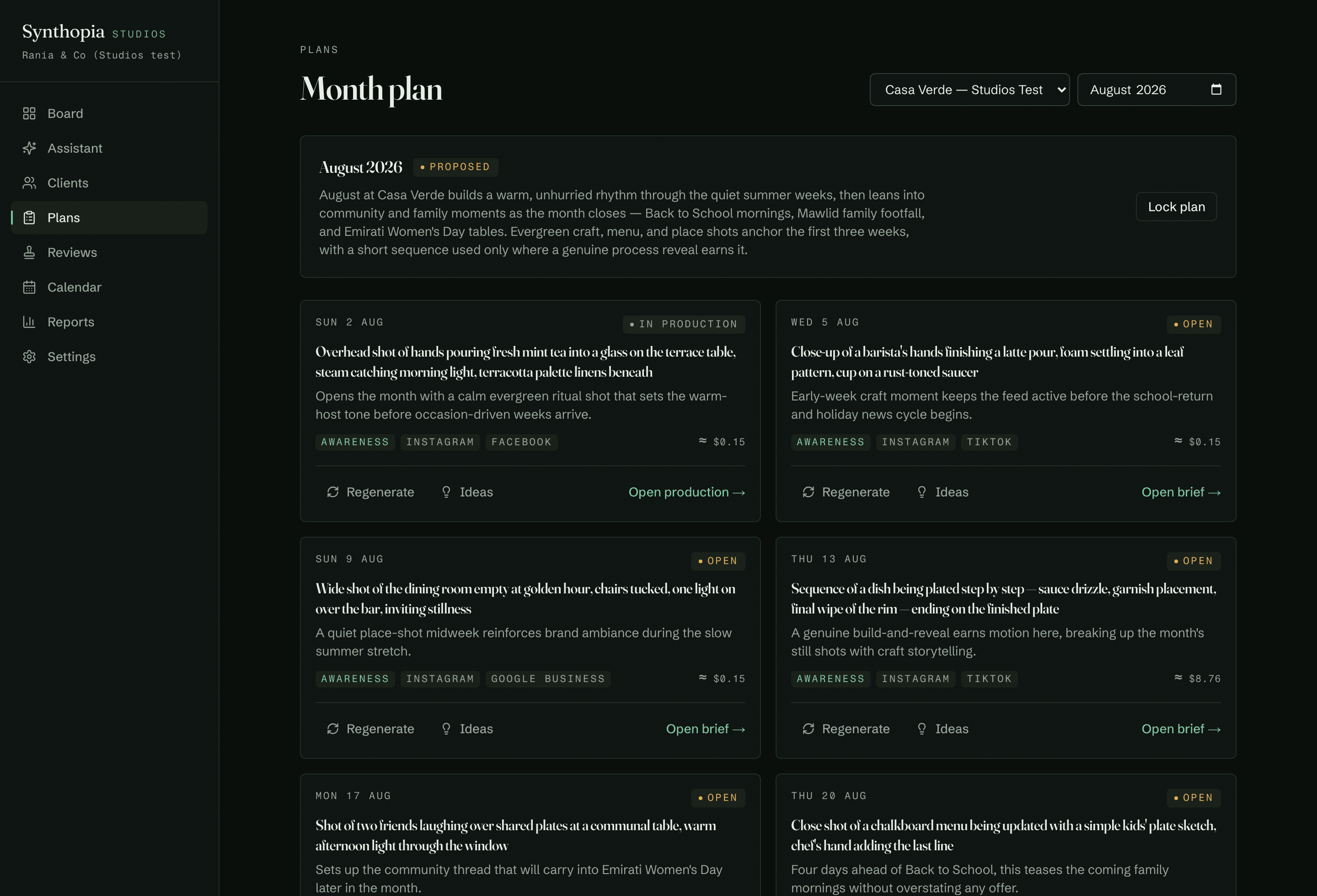
01 · Plan
Propose the month
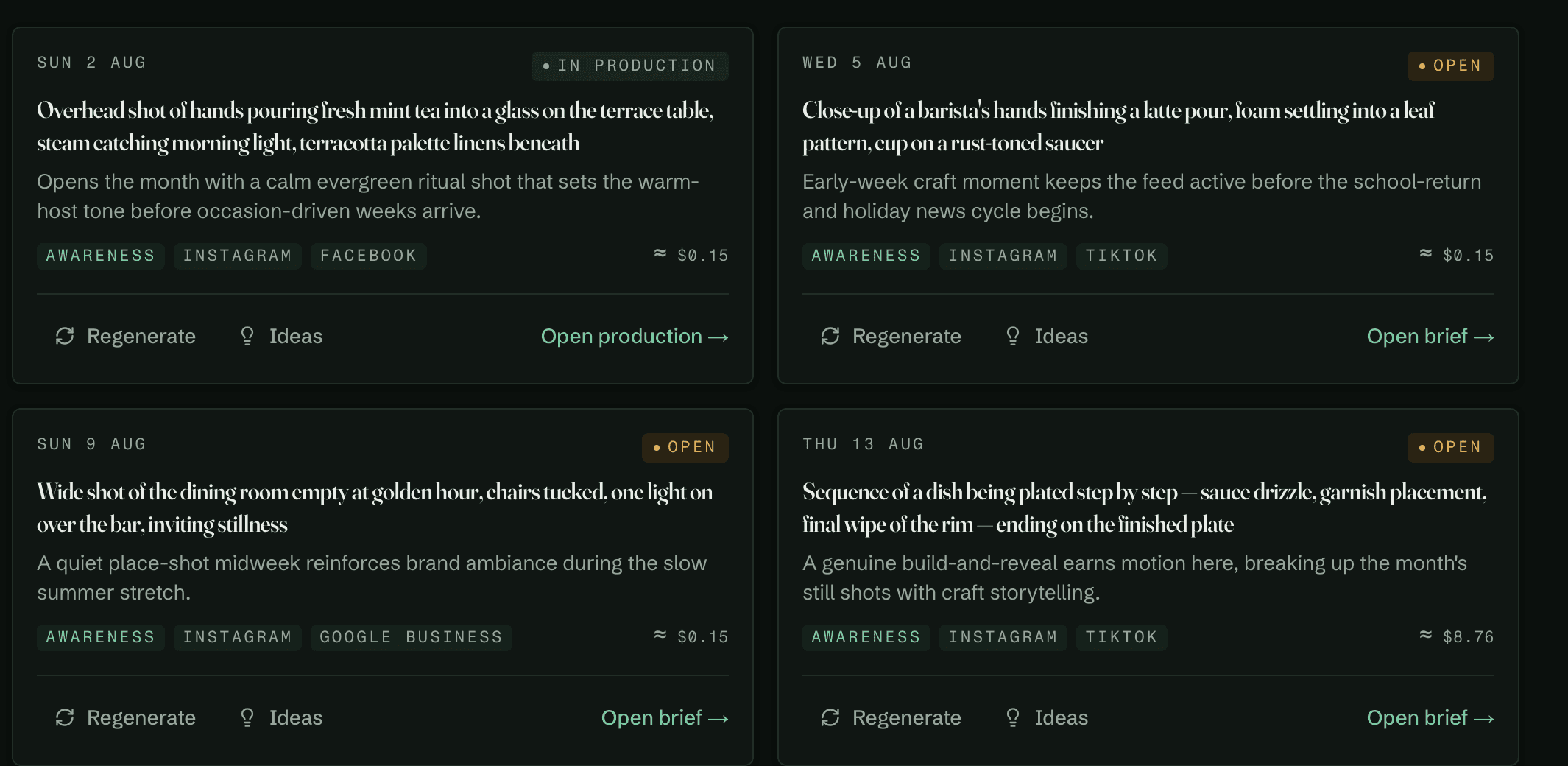
02 · Direct
Art-direct the shot sheet
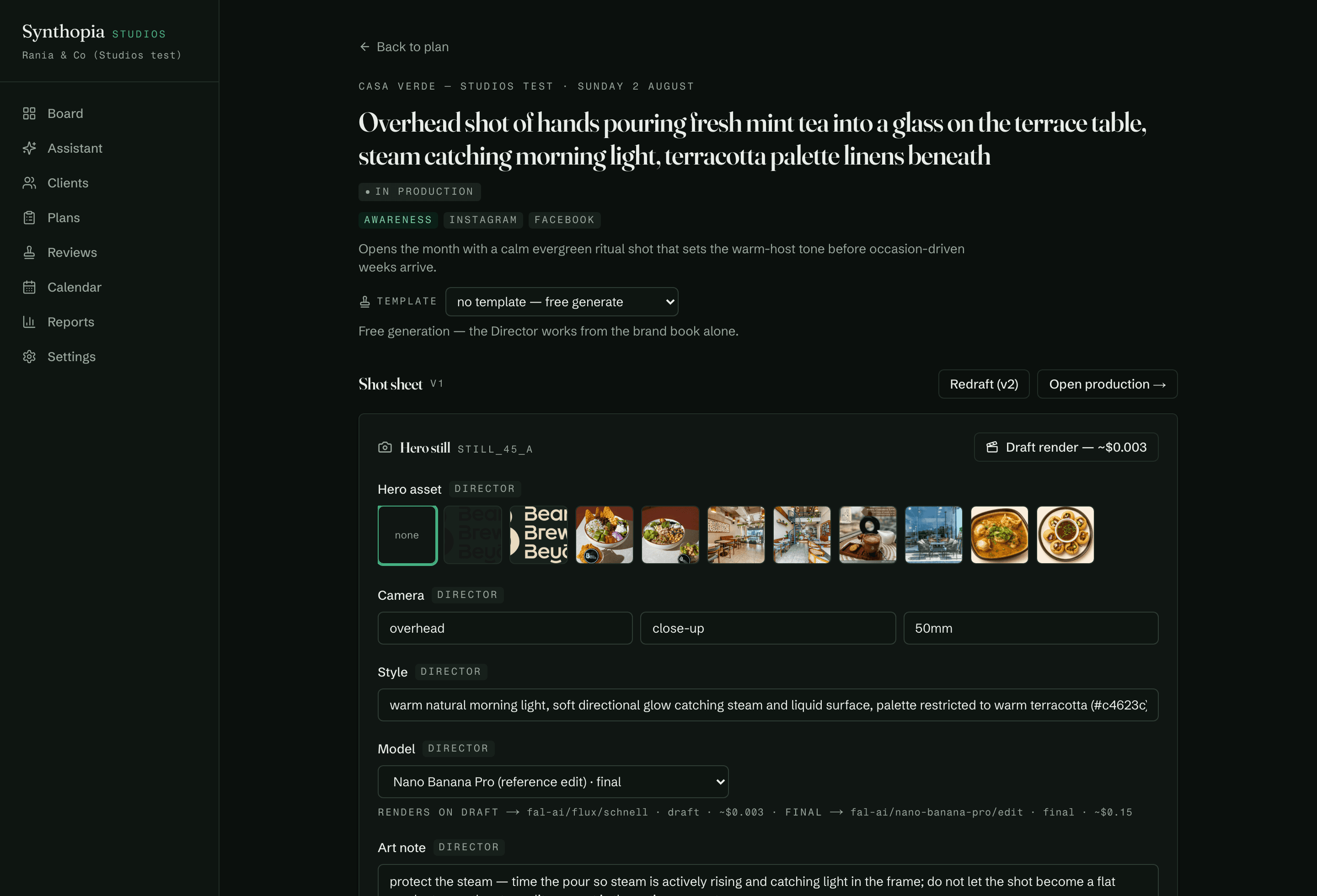
03 · Approve
Your client approves from the sofa
One link per named reviewer, no account, no app, no password. They see finished work only — never a watermarked draft — and “approve all remaining” is the hero button, because a month approved in one tap is a month that ships.
With several reviewers, the worst verdict wins: one request for changes beats any number of approvals, and both names stay on the thread. Silence never approves anything.
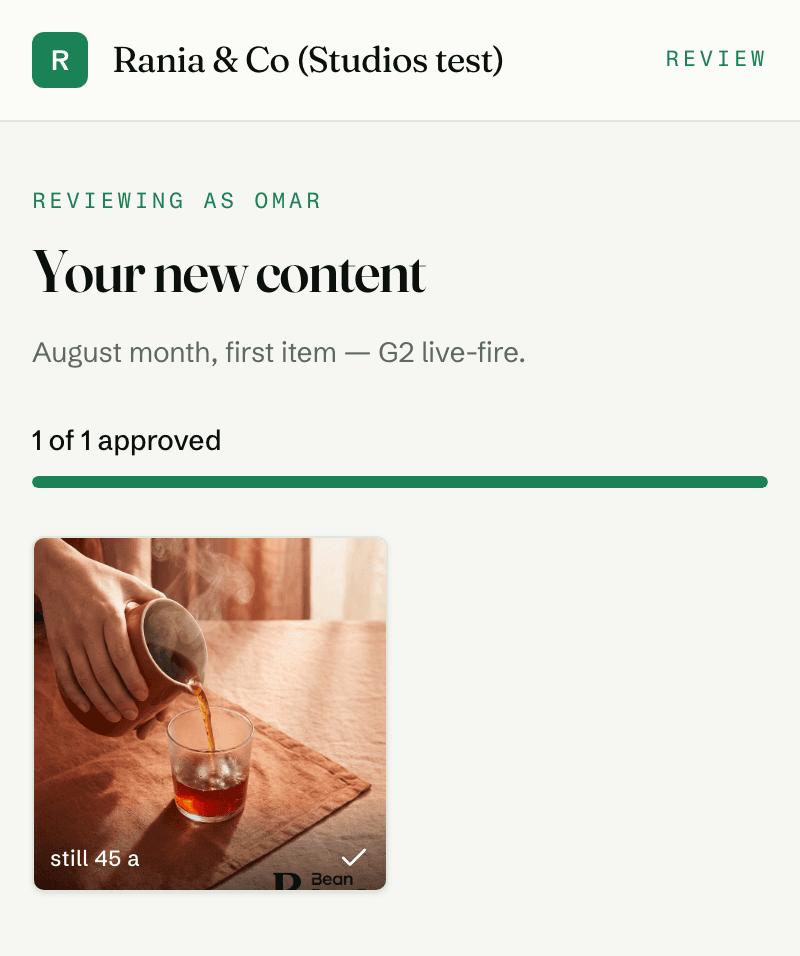
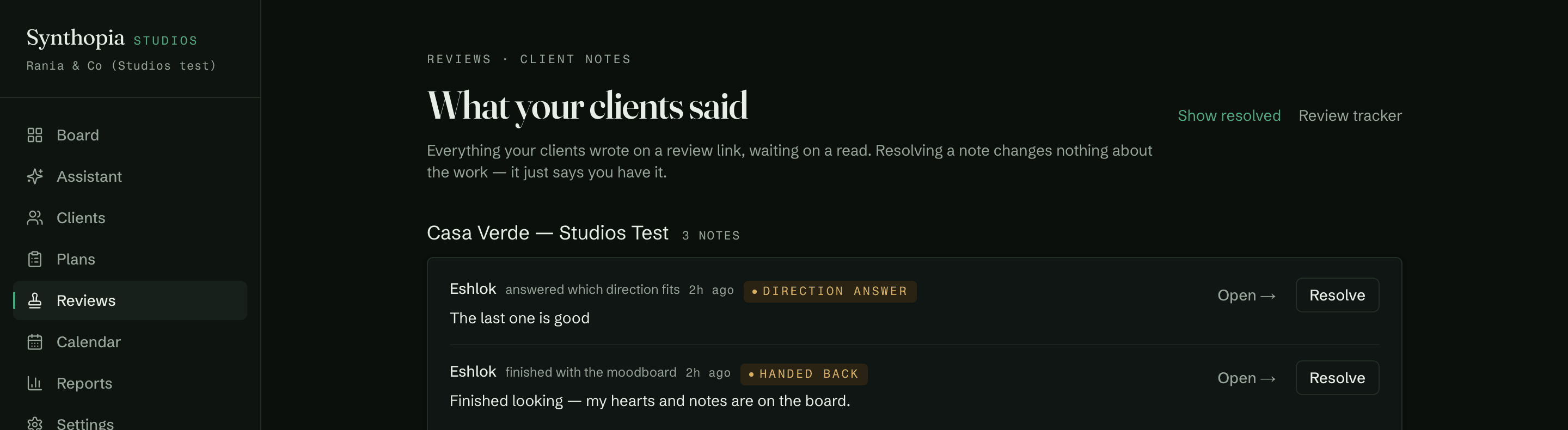
04 · Absorb
Everything they said, in one queue
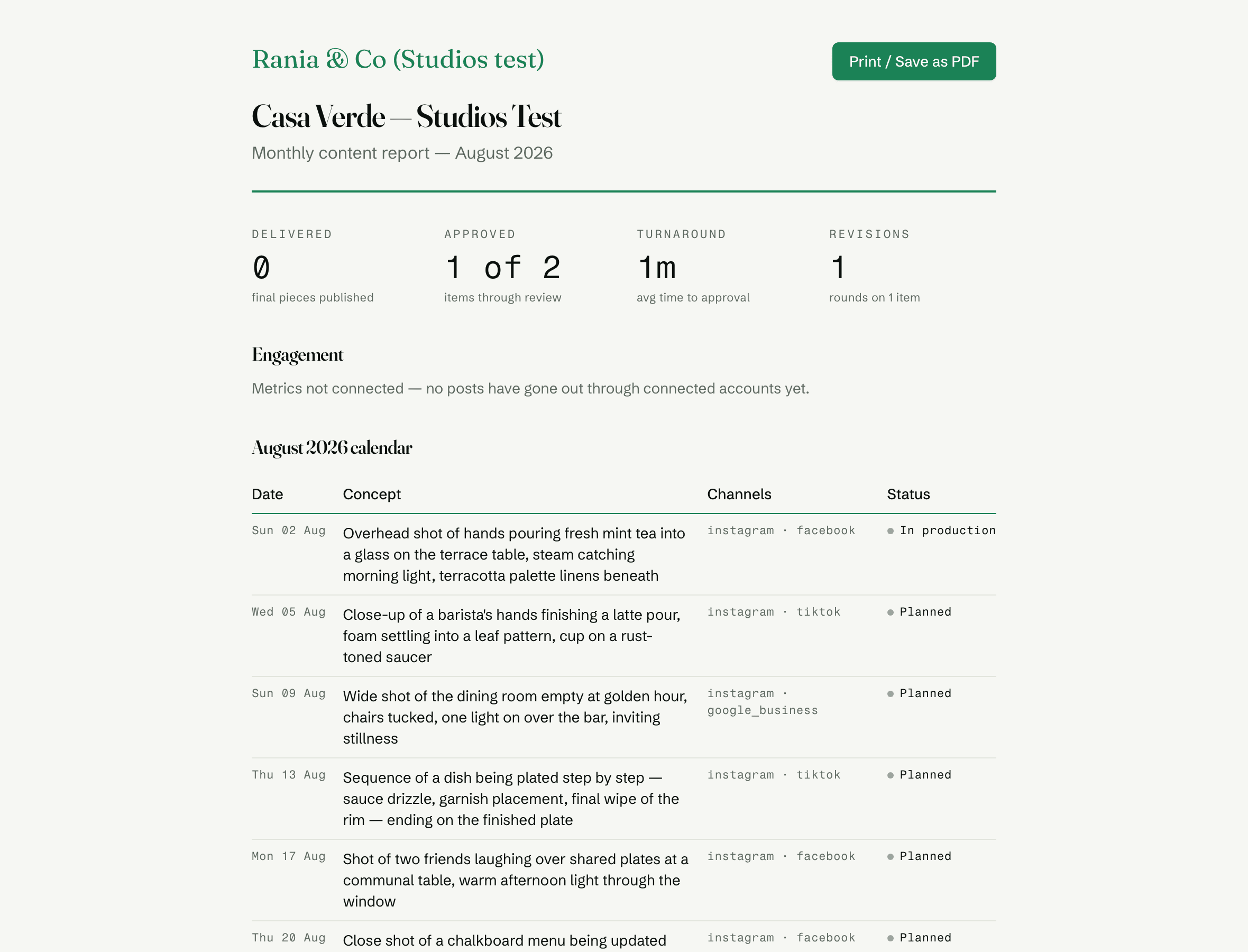
05 · Report
Month-end, with their name on it
The wedge
When your client clicks “request changes”, every other tool’s job ends.
In a scheduler, a change request is a notification. Somebody reads it, retypes it into a brief, chases a designer, waits, uploads, and asks the client again. That gap is where agency months die.
Here it is a render. The moment your client submits the note, their own words are appended to the art note and a draft fix renders immediately — for about a third of a cent — and waits in the thread for your confirm. You approve the fix, the final re-renders, and only the changed items go back for a second look. Nobody re-approves eleven things because one moved.
That loop is only possible because approval and generation are the same system. It is the one thing a scheduler bolted onto a design tool structurally cannot do.
- 01Client writes the noteOn their phone, in their own words. No account.
- 02A fix drafts itself≈ $0.003, immediately, before you've read the comment.
- 03You confirm — or don'tThe client never sees the intermediate draft.
- 04Only the changed items go backRound 2, fresh links, same reviewers.
What it replaces
You are already paying for this. Just in seven places.
- Intake formTypeform, Google Forms, a Word doc
- Moodboard toolMilanote, Pinterest, a shared drive
- Content plannerNotion, Airtable, a spreadsheet
- DesignCanva, or a designer, or a shoot
- Approval toolFilestage, ReviewStudio, email
- SchedulerLater, Buffer, Metricool
- ReportingA monthly slide deck somebody builds by hand
- Five to seven subscriptions, and the handoffs between them are where the month actually leaks.
The line item under all of it
$500–3,000/client/month
Production labour: the designer, the retoucher, the shoot day, the freelancer who turns twelve concepts into twelve finished posts. It is the biggest number on the client’s P&L line and the one nobody has been able to compress.
We replace that line, and only that line. Not your strategy, not your taste, not your relationship. The brief is still yours; so is every yes and no along the way.
White-label
Your client never meets us.
Every surface a client touches — the intake link, the review link, the report — wears your logo and your colour, and asks them to sign in to nothing.
- Your logo, your colourSet once when you sign up; it themes every client touchpoint from then on.
- Your name on the emailReview invites and nudges send under your agency's name, from our address.
- No account for the clientSigned links, per person, expiring and revocable. Nothing for them to forget.
- One line of oursA small “Powered by Synthopia” in the footer. That is the entire extent of us.
The print view of a real report from our test agency. The only Synthopia mark on it is the footer line.
The brand book
Their brand law, made machine-enforceable.
Every client gets a book: palette, logo rules, typography, photography, tone, lexicon, banned claims, hard nevers. Four writers fill it — a crawl of their site and Instagram, their official PDF read page by page, their own answers from a two-stage intake, and what the system learns from their review comments.
Crawled
Observed on their site and feed.
Compiles as a suggestion.
Inferred
The system's own deduction.
Compiles as a suggestion.
Imported
Their official brand PDF, page-cited.
Becomes binding.
Confirmed
A human said so — usually the client.
Becomes binding.
The book fires in three places
It compiles into every render’s contract, it runs as an automatic adherence pass when a final reaches QA — palette distance, logo rules, banned words, photography nevers — and it shows as binding lines on every brief. Failures flag loudly. Nothing auto-passes.
And when the book and the feed disagree
You get a drift report — “the book says terracotta, the feed is cool-toned” — surfaced for you to resolve rather than silently merged. It is a very good thing to be holding in a first client meeting.
Pricing
Two plans. Monthly. No lock-in.
Seats are unlimited on both — put your whole team in without arithmetic. There is no annual plan and no launch discount; the price on this page is the price.
Studio
$749/month
The shop with a dozen retainers and one person holding the calendar together.
- 12 client brands
- 120 final renders a month
- 8 hero reels a month
- Unlimited seats
- White-label client links, intake, reviews and reports
Studio Pro
$1,499/month
The shop where content is the product and the calendar never stops.
- 30 client brands
- 300 final renders a month
- 20 hero reels a month
- Unlimited seats
- Everything in Studio
45-day refund
Full refund on your first month, for 45 days, no argument. Long enough to run a real client month and decide with evidence.
What the money buys
Production for a client month costs us under $100 at the top end. On a $1,500 retainer, swapping a production line item for those hours moves an agency’s yield from about $125/hr to $210+/hr.
That last number is our model, built from our own costs and the hours at the top of this page — not a customer’s result. We have no customer results to quote yet.
Each plan also carries its own monthly lines for draft renders and reference-guided moodboard images; you can see every counter in the console. Carousels count one final per slide, because each slide is a render. Reaching a limit is never a hard stop mid-render — it offers a top-up or an upgrade in the same click.
The first cohort
We onboard you personally.
There is no signup button on this page, and that is deliberate. Agency onboarding is founder-led at launch: I set up your agency with you, put your first client through the loop alongside you, and stay on the thread while it happens.
Tell me about your shop below and I’ll email you within a day — a real reply, not a sequence.
Who you’ll be talking to
Ex-VP marketing at Noon Food, now operating cafés and hotels across the UAE, Thailand and India — which is to say: someone who has been the client on the other side of an agency’s approval email, many times.
Questions worth asking
Including the ones we’d rather you asked now.
What if the output is generic?
That is the right worry, and the brand book is the whole answer. Only confirmed and imported fields become binding lines in the render contract, so a client’s own words outrank anything a machine guessed. Every final is checked against those binding fields automatically before it reaches you, and failures flag rather than pass.
Beyond that: you can run a bake-off across every capable model and pin the frame you want, and you can iterate on drafts as long as you like — drafts cost about a third of a cent. Taste is still yours. We just make exercising it cheap.
Who owns the client's brand if we part ways?
They do, and it is enforced in the schema rather than promised in a contract. A client brand carries no membership row for your agency — one link, which can be cut. The brand is detachable with its entire history at any time, in every billing state, including a cancelled one. Custody outranks billing here.
Does my client know you exist?
Only from one line: a small “Powered by Synthopia” in the footer of the links they open. Everything above it is your logo, your colour and your agency’s name — including the sender name on the emails.
How do revision rounds work?
Your contract’s included rounds are what the client sees: “Round 1 of 2” on their own link. Past that, nothing blocks and nothing scolds them — the board simply surfaces it, because a fourth round is a commercial conversation, not a software event.
Does it publish for me?
Partly, and here is the honest version. Your client’s accounts can be connected — Instagram, Facebook, TikTok, X, YouTube, Google Business — and approved items schedule and publish through those connections, with engagement flowing back into the monthly report.
Anything outside a connected account you mark published yourself, and the report counts it. A fully hands-off publishing queue that covers every channel is not built yet. We’d rather write that here than let you find it in month one.
Can I sign up right now?
No — and that is a real answer, not a scarcity tactic. Billing is wired, but agency onboarding is founder-led while we take the first cohort. You fill the form, I reply within a day, and we set your agency up together. Self-serve agency signup comes after the first agencies have run a real month.
What happens to my client's links if my card fails?
Nothing. A past-due account blocks new renders but never strands work in flight, and a cancelled one turns the console read-only while every client review and intake link keeps working. A client mid-approval should never be punished for an agency’s billing problem. That is a law here, not a courtesy.
Where does the client's data live, and what do they have to sign up for?
Nothing at all — clients never create an account, so there are no client credentials in existence to leak. Their links are signed tokens, stored only as hashes, scoped to one named person, expiring, and revocable the moment you resend. Their content and their brand book live in our database, and leave with them if they go.
Where we actually are
No logos on this page, on purpose.
Synthopia Studios has no agency customers yet. You would be among the first, which is why there is a form here instead of a checkout, and why you will not find a testimonial wall or a row of borrowed logos anywhere on this page. We could have written them. We are not going to.
What does exist: the content engine underneath this is live and paid for by food and hospitality operators today, every screenshot above is the working product on real client data, and the person on the other end of that form spent his career on the client side of this exact relationship — ex-VP marketing at Noon Food, now operating cafés and hotels across the UAE, Thailand and India.
When we have agency results worth quoting, they will appear here with a name attached and permission to use it. Until then, this page is what we can prove.